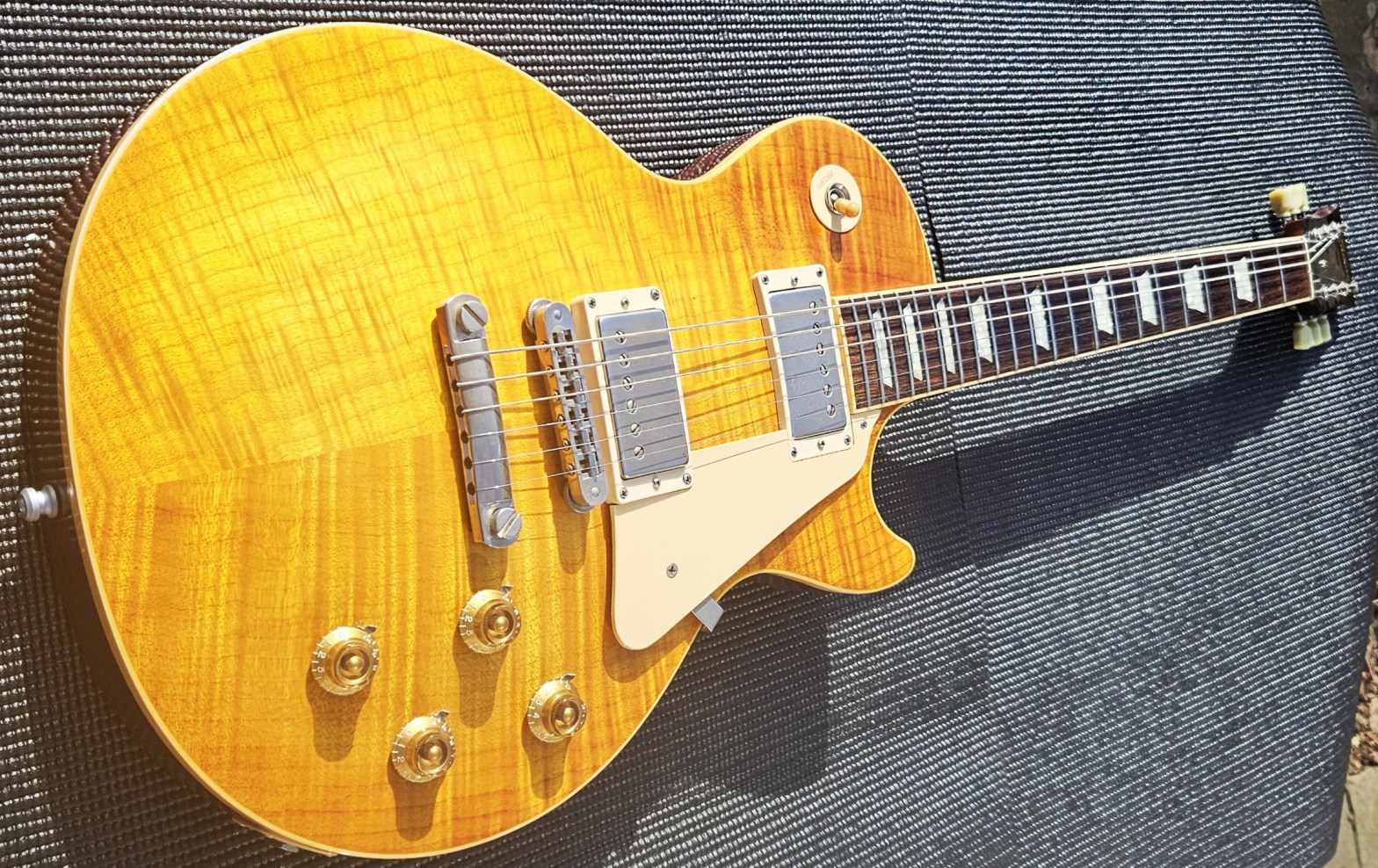
62. 2005 Faded Honeyburst Gibson Les Paul Standard
I BLAME that American bloke Trogly. It took the best part of a decade and a half, but in 2023, it finally happened…the Fender nut finally went fully over to the Dark Side and splashed the cash on “brand G’s” most iconic axe!
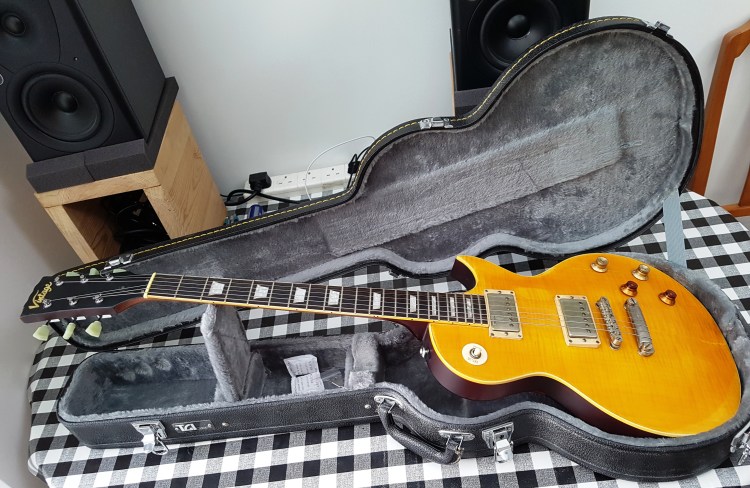
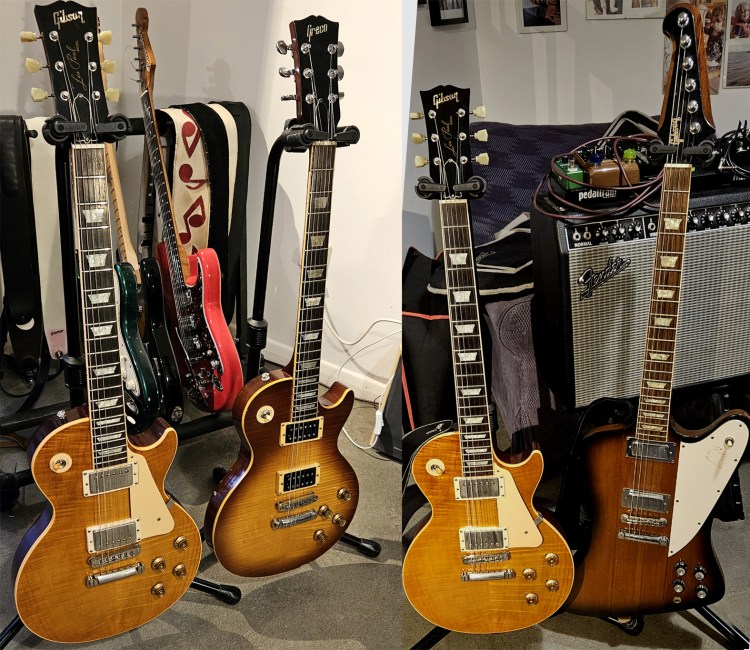
Of course, I’ve dabbled in the past in the wonderful world of Gibson and also with Les Paul-shaped guitars. First there was the Vintage Lemon Drop (No 37 in this blog), a cheap, cheerful, but perfectly playable take on the Lester, which served me extremely well. Then there was the 1976 Japanese Greco LP Owen convinced me to buy from a shop in Santa Monica in 2017 (No 50). I’ve still got that one and I still appreciate it as a very nice instrument in its own right.

For many years, I also gave a home to a brace of nice old Goldtop Les Paul Deluxes belonging to my dear old pal Dave Werewolf. Dave moved to Thailand some time ago, leaving a ton of his gear in my custody. His 69/70 Deluxe, complete with the original mini-humbuckers (I recently sold it for him) was too valuable for me to take out and gig, but he has granted me occasional gigging use of his 72 Deluxe. It had been converted many years ago to take full-sized humbuckers and was a lovely instrument – a screamer for sure, although heavy as hell. I really enjoyed playing it, but earlier this year it finally made its way out to Dave in Pattaya.

Towards the end of 2022, I started warming to the idea of an actual, made-in-the-USA Les Paul Standard. I mostly blame this geeky American YouTuber named Austin, who lives somewhere in the Midwest and goes by the unlikely nom-de-internet of Trogly.
The Trogly’s Guitar Guide is a video blog on which, basically, he talks guitars every day. His business is buying and selling guitars and he does pretty well, judging by the size of the house to which he recently moved. He has a massive collection of valuable, interesting and extremely desirable guitars. He’s even thinking about opening a Gibson museum to show them off. Gibsons – and Les Pauls in particular – are Trogly’s specialty. Over the years, he’s owned and played a lot.
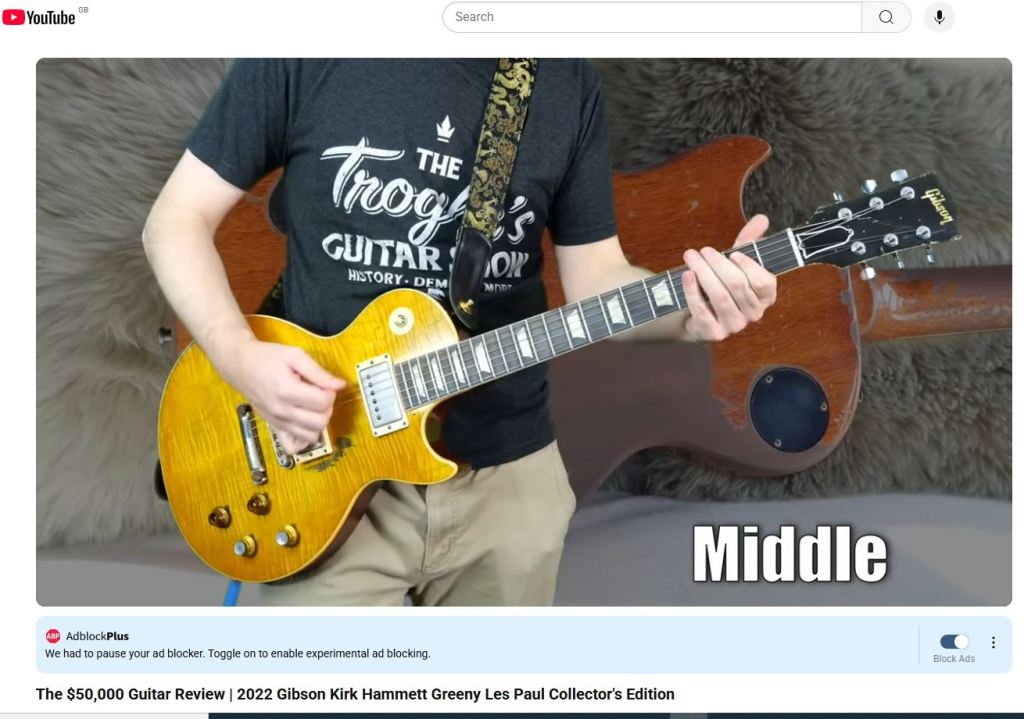
Trogly’s “daily dose of guitar information” has been my lunchtime viewing of choice for some time. (Along with Matthew Scott’s wonderful vintage guitar and amp videos, my old mate Colin’s Southend-based The Guitaristas vlog and the web’s sweariest guitar-builder Paul Richards’ super-entertaining Milehouse Studio videos.)
I’ve learned a lot from Trogly. I know a reasonable amount about Fenders – not enough to call myself an expert, but enough for me to look at a Strat or Tele and be reasonably sure if it was worth the asking price. But until I started watching Trogly, I felt I didn’t know enough about Gibsons to commit a sizeable chunk of cash to one.
Of course, I already owned one Gibson, my 1991 Firebird V (No 36). I snapped up that bad boy in 2003 for a price which meant I really couldn’t go wrong. There was also a previous, less auspicious purchase, a cherry red Les Paul Special I got brand new in Mars Music in Austin, Texas in the late 90s, when the exchange rates were still crazily favourable (No. 13). Sadly, I never kept that one long enough to really appreciate it.
Clearly, I needed to get me some learning! Originally, my Les Paul obsession coincided with a minor crisis in my finances., which meant for a couple of years, I was generally selling guitars and amps, not buying new ones (yes, really!) Eventually, I baled myself out by parting company with a house I’d bought as an investment and had been renting out.
It took bloody ages. I won’t go into the tiresome details (basically, a buyer who pulled out and an unaccountable amount of incompetent and bizarre behavior by members of the legal profession). All through those months, the thing that sustained me was the notion that soon, I could finally treat myself to a Les Paul.

Hours of poring over videos, books and pictures online helped narrow down the options. Remembering that little Vintage Lemon Drop from my WOLFPACK days, I decided Peter Green’s fabulous 59 Standard, “Greeny”, was a fair visual benchmark. I’ve already written a fair bit about the real Greeny in the “Fantasy Fretboards” section of this blog.
A 50s-style Standard with a decent flamed maple top was a given – preferably evenly and carefully bookmatched. (You see a surprising number of Gibsons where the two halves of the top give the impression they’ve been matched by a blind man! Just plain WRONG!)
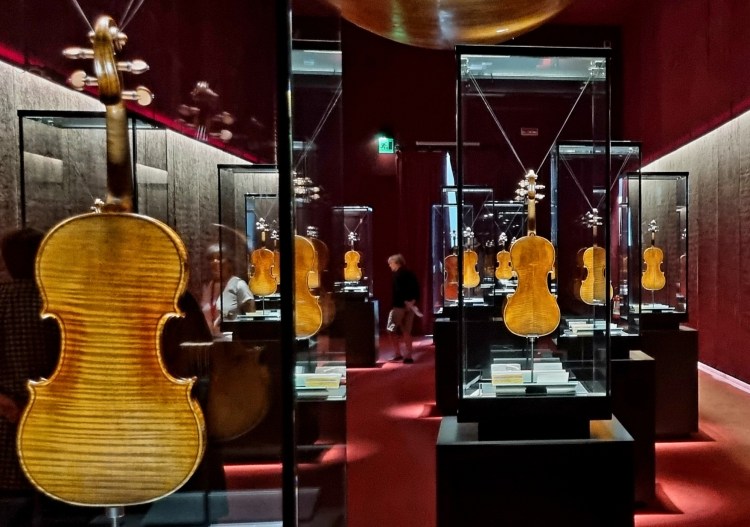
While on holiday in Northern Italy, I visited the Stradivari museum in Cremona, home to some of the master violin-maker’s most beautiful maple-backed instruments. It’s clearly where Gibson got the idea for both the bookmatching and the sunburst finishes. If anything was going to fuel my quest for a really handsome top, it was the morning I spent in awe of a roomful of gorgeous old violins and viola, each worth several times more than even the most expensive ’59 Burst.
The look I particularly loved was that golden, lemony, faded finish you get on old ‘Bursts practically when the years have faded away practically all the red from the original finish. The more pictures of ’Bursts I gazed at, the stronger became my aversion to the gaudy, bright red cherry sunbursts you sometimes see – “clown bursts” they call them. “Not too much red” became my watchwords.
I’ve never much liked really big, fat necks on guitars, although as I’ve played more guitars, my toleration for different profiles has grown. The neck on that Esquire I built a couple of years ago is definitely a handful, although it’s actually one of the most comfortably-playing guitars I own. The Esquire is very often in my hands as I sit at home watching the telly and that made me realise a bigger 59-style Les Paul neck would fit the bill, rather than the 1960s profile.
Then there was the weight. I’ve long been a fan of really light, very resonant guitars – two of my Strats, the Sherwood green one Owen built me and my JV Squier, weigh next to nothing. Trogly’s reviews are nothing if not thorough and every single guitar gets weighed and measured to within an inch of its life. The general consensus is that a “good weight” for a Les Paul is anything between 8lbs and 10lbs. My featherlight Strats are both in the low sevens, so something in the 8-9lb region ought to be OK, I figured.
Those considerations aside though, it was always going to be down to cosmetics, the things that spell love at first sight – or not. The 1960s-style Grover tuners are generally considered more mechanically sound, but I’d always preferred the look of cream tulip-buttoned Kluson Deluxe style machines. I also greatly prefer the look of covered humbuckers.

Soundwise, I wasn’t really looking for crazily high output pickups, just a sweet-sounding set of with the look and sound of classic 1959 Patent Applied For (PAF) humbuckers. I wasn’t interested in fancy phase splits or coil switching options like those offered on some modern Gibsons. Nor was that Peter Green out-of-phase thing with both pickups on, something I particularly craved, even though my Vintage Lemon Drop had been wired that way.
Budget-wise, I now had the cash from the house sale burning a hole in my pocket, and so I could have sprung for a tasty morsel from the Gibson Custom Shop, or even one of those meticulously aged Murphy Lab guitars. (I’ve never been a fan of new, shiny guitars – they don’t really stay that way with me when I gig them!)
Annoyingly, then, when I started looking in earnest, I found myself instinctively drawn to the most expensive Gibsons I could find. It was one of those cartoonish situations where the little red-horned devil perched on one shoulder was urging me to throw caution to the wind – while the angelic figure on the other battled to hold him back!
In the end, the sensible little guy with the halo won the day. I set myself what many a Gibson buyer would still consider a modest budget, £2,000, give or take. At the time, it was roughly the price of a brand new Les Paul Standard if you struck a hard bargain with a shop – not that I really like new guitars. I’ve actually bought very few down the years and would far rather own an instrument that has been gigged, lived a bit of a life and acquired a bit of mojo before falling into my hands. Not necessarily heavily road-worn, but certainly an instrument another player has already taking the trouble to ding.
So, time to actually go out play some Les Pauls… I played a stunning secondhand Murphy Lab ‘59 reissue in a music shop in Newcastle when we went up there to see Bonnie Raitt. It was bloody gorgeous, played beautifully, although the nut needed a bit of lube – the G string kept going sharp!). It sounded incredible, too. One small snag: Even secondhand, the price tag was £8,500! Ouch!
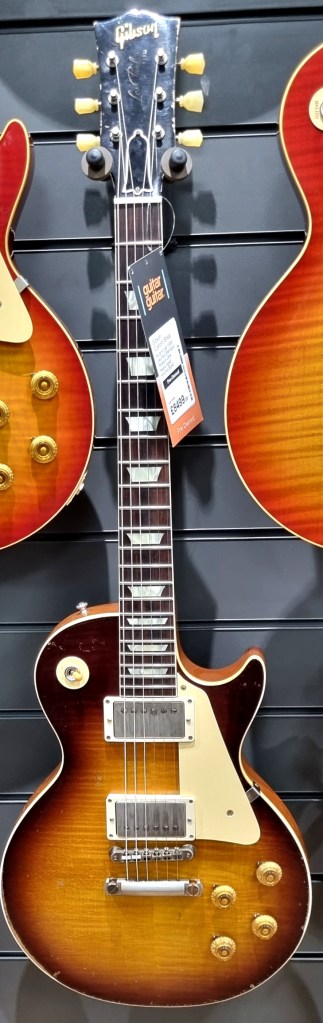
I looked at a few secondhand ones nearer to home, but none of those within my budget really floated my boat. I also spoke to a couple distant dealers about guitars they were advertising online and started planning to go and see them. Sadly, I wasn’t the only person looking for something similar – three times I was all set to go, only to be told someone had just snapped up said guitar before I could get there.
It really was dangerously frustrating. I also found a couple of local possibilities. There was a handsome one on Facebook Marketplace in Chelmsford. It looked fabulous – until you flipped it over and spotted the repaired neck break in the very spot Les Pauls are infamously prone to break. No matter how expertly they’re fixed – and it’s often said they’re stronger and actually sound better after a good, professional repair – such a move shaves between a third and a half off the resale value. And the guy simply wanted too much for it. I haven’t looked lately, but I wouldn’t be surprised to find it’s STILL for sale!
There was another one on Marketplace in Colchester, roughly the right spec and the right colour. Two things put me off: It was advertised at £300 more than my £2,000 limit; and judging by the photos, I wasn’t sure about figuring on the maple top.
Fortunately, just after the third guitar I’d been interested in driving a 150 miles to try sold before I could get there, the Colchester guy dropped his price by £300…
The seller’s photos truly didn’t do it justice…In the flesh, with the light playing on the top, what in the pictures looked quite unprepossessing turned out to be a very impresive symphony in pale, bookmatched maple. Not, perhaps, quite as perfectly matched as those old violins in Cremona, but uniquely figured, with a grain pattern that moved in the light. Look at it one way and it was intricately flamed; turn it through 90 degrees and it showed beautiful, dark, wavy lines running lengthways.
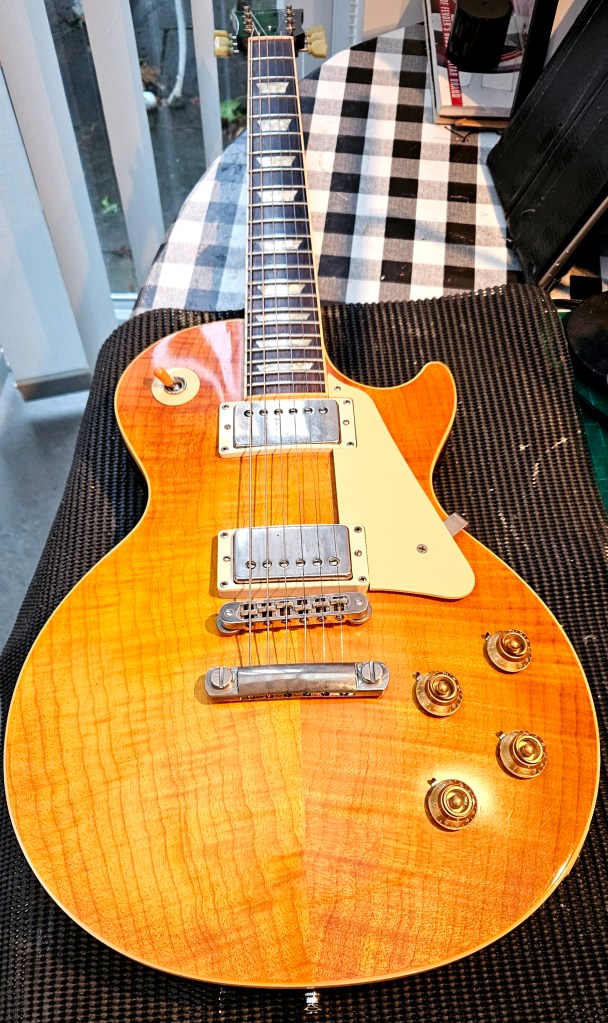
I picked it up, quietly praying it would play well, too. It did. It played beautifully – one of those rare guitars that, like that Sherwood green Strat Owen built for me, you pick up and really don’t want to put down. Ever.
The neck was chunky – fatter than my Greco, most definitely more 50s than 60s – but not unmanageable. It was heavy – well outside my ideal eight-and-a-half to nine pounds, but nothing a wide strap to spread the weight wouldn’t sort.
The pickups weren’t original. They were old (quite sought-after in their own right, I later learned) Seymour Duncan. The neck pickup had had one of its magnets flipped to do the Peter Green out-of-phase thing. A fairly logical choice I suppose, since visually, the guitar gave off definite “Greeny” vibes. I guess the original owner, the one who had replaced the original Burstbuckers must have been a fan of Mr Greenbaum.
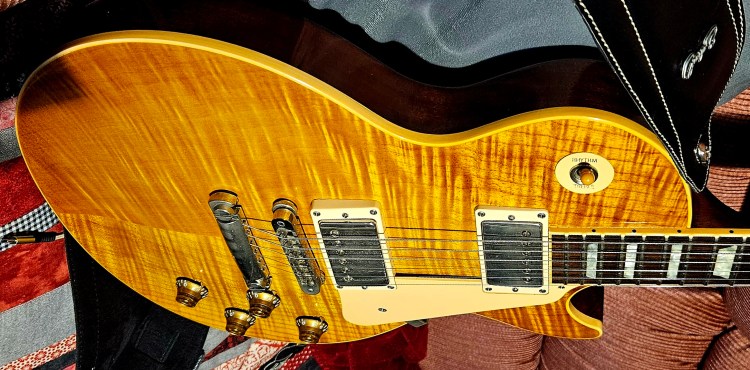
The seller was a really nice chap, not a gigging player, but clearly a genuine lover of guitars and guitar players – it turned out he’d recently been to see a couple of fairly high-profile blues players I actually knew.
He didn’t put me under any pressure. We sat there for ages chatting while I noodled away. He was an enthusiast for old Volkswagens, he said, and was selling the Les Paul to help fund the restoration of an old 60s split-screen VW bus. The flat was littered with VW panels and other parts he’d been stockpiling for the project and he showed me pictures of the work in progress.
Eventually, crunch time. came I definitely wanted it, but could I justify spending £2,000 on the guitar? If I did, it would instantly become the most expensive guitar I’d ever bought…
“It’s a fantastic guitar,” I told him. “I love it, but I’m afraid I’m going to have to walk away, because I simply can’t afford it.”
I meant it, too. I think.
To which he countered: “Make me an offer. You don’t know what I’d be prepared to take for it.” I made the offer. He countered saying if I could add £100 to that sum, I could have it. I could and I did. That was that. I gave him a deposit and walked away without the Les Paul, but with a large smile on my face.
Two days later, I was back with the rest of the cash. I finally had my Les Paul…
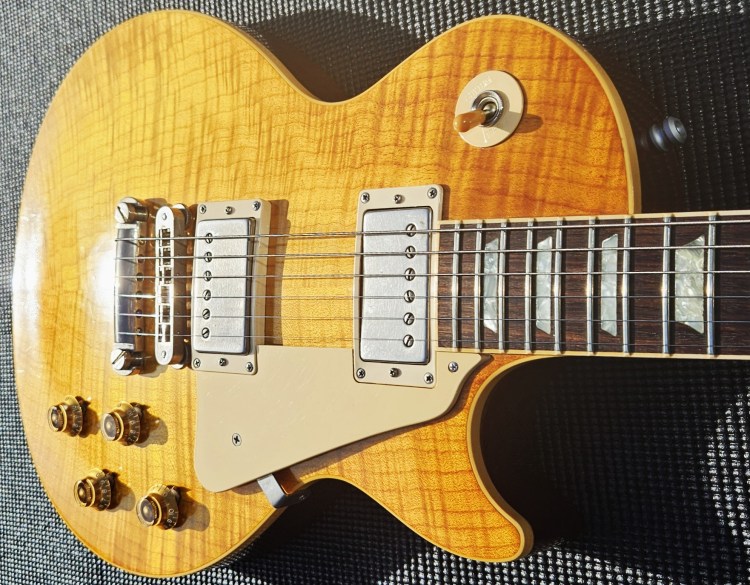
Me being me, of course, I’ve already carried out a few mods. First thing to go was that flipped magnet. The old “Greeny” thing is a nice enough sound, but not one I find myself wanting all that often. I’d never performed open-heart surgery on a pickup before, but after watching some YouTube videos, I took a deep breath and flipped the magnet. Easy-peasy. Who knew? Just unsolder the chrome cover, pull out the magnet and slip it back in the right way up and solder the cover back on.


Eventually though, I decided I wanted something a bit more “vintage” and PAF-sounding. After lengthy conversations with Owen, I settled on a set of “Spirit of 59” PAFs from the German company Amber Pickups. They are fitted as standard on the Maybach guitars Owen endorses. They weren’t cheap, but they truly do what it says on the tin.

The next change I’d been resisting for some time – a set of Schaller strap locks. I used to use Schallers all the time, but they’re ugly and after a while prone to rattle a bit. Over the years I’d moved back towards traditional strap buttons, or trapezoidal buttons like the ones Gibson itself used at one time. I did try a set of the diamond-shaped buttons on the Les Paul, but one night on a gig, the strap came off the front button and my precious guitar crashed head-first to the floor. I could barely bring myself to look at the headstock. Miraculously, it remained intact. It was even still in tune. So strap locks it had to be.
This Les Paul is a fabulous guitar, a thing of beauty and a joy to behold and to play. It often sits on a stand next to the TV, so I can just look at it. I never seem to tire of doing that.
Then I pick it up and play, my fingers somehow falling into different places to where they might with a Strat or a Tele. I find myself rather inexpertly trying to fashion Billy Gibbons licks, bits of Paul Kossoff and working out Thin Lizzy songs (surely one of the ultimate Les Paul bands!)
No regrets. I DEFINITELY made the right decision on this one.

POSTCRIPT:
It turns out that leaving my beloved Les Paul proudly on a stand in my living room would be my undoing. It was sitting on its nice, secure Hercules stand – one of those ones with little arms that flip out and hold the guitar in place after you hang it in the stand. I walked across the room and, like a total idiot, got a cable wrapped around said stand, precipitating a disaster.
Over went the stand. Down came the guitar. Crack went the headstock! Heartbreak.
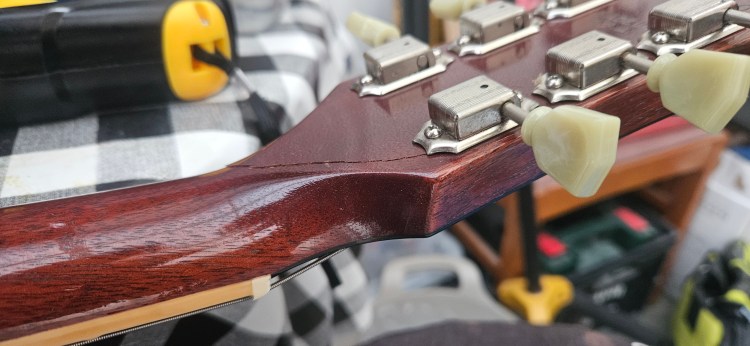
I was in a mild state of shock for a good ten minutes. The head hadn’t come completely off, but a nasty crack had opened up on the back, at the point where Gibson headstocks generally break. Finally, I came to my senses, slackened off the strings and contacted the best guitar repairman I know.
James Payze lives just outside Sudbury, Suffolk . Aside from being one of the nicest people I’ve ever met, James is pretty much an all-round genius. A talented singer, guitarist and bassist, he also plays pretty respectable drums and keyboards and knows his way around a recording studio pretty well. He’s also an amazing craftsman. I knew if anyone could help me, James could. I sent pictures and a heartfelt plea. James isn’t just good. He’s super-good. He also builds beautiful guitars 100% from scratch – my WOLFPACK buddy Joel has a stunning Les Paul Junior, one of a pair James crafted from a desk, reputedly taken from a South African diamond mine…
He’s also very adept at fixing the handiwork of destructive idiots such as myself. As a former repairman for Gibson importer Rosetti, James truly knows his stuff and evidently, has seen his fair share of Brand G headstock breaks in his time. His verdict? “A nice, easy one that.”
The next day, the guitar was on James’s bench undergoing surgery. Five days later, I had my Les Paul back, the crack having been gently eased open, some special glue injected into the break and the appropriate clamps applied while it sat over the weekend.
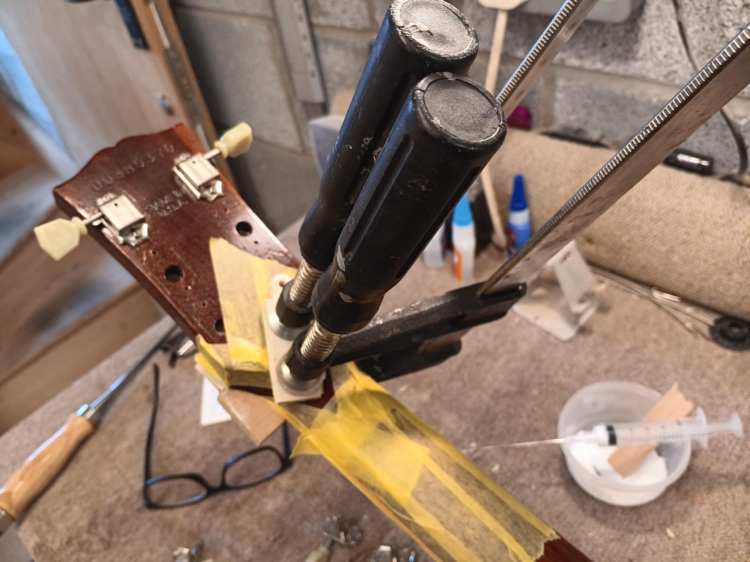
The repair isn’t exactly invisible, but you have to look moderately hard to see the join. “It went back nice and flat,” was James’s comment.
It seems to be as strong as ever – in some circles, legend has it that Les Paul necks are actually stronger and sustain better if they’re repaired properly. The jury’s out on that one. What I will say is that it sounds great and yes, it sustains really well. How much of that is down to James’s repair and how much to the new strings he fitted is open to debate.
Either way, though he saved my bacon…thanks James.
 43 Guitars…and Counting!